I woke up.
Shower.
TM meditation.
Surya Namaskar.
Pranayama.
On the right side of the bed, Tessa was still asleep.
She looked like Botticelli’s Venus after the painting had been rotated ninety degrees.
Horizontal Venus.
I finished my practice and went into the living room to answer yesterday’s emails.
Then – the bathroom door.
Tessa was awake.
I went back to the bedroom for my charger.
On the bed, which had become neat again after sleep, there was a book.
Tessa had brought me a gift from Amsterdam.
What a gift.
Priceless.
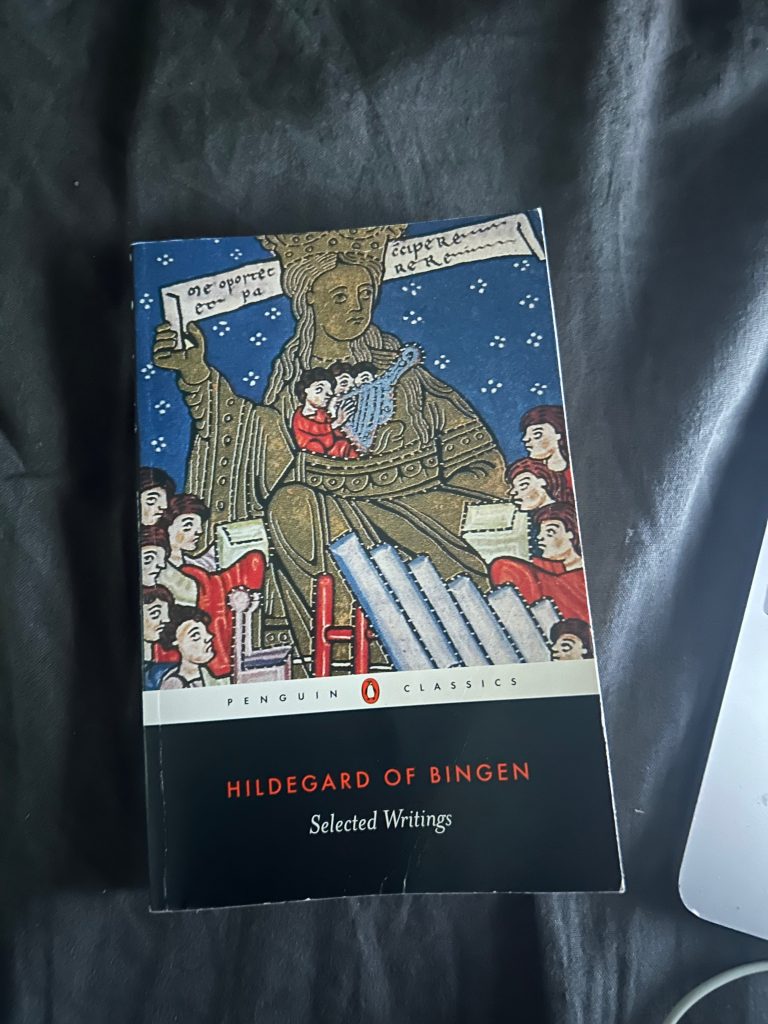
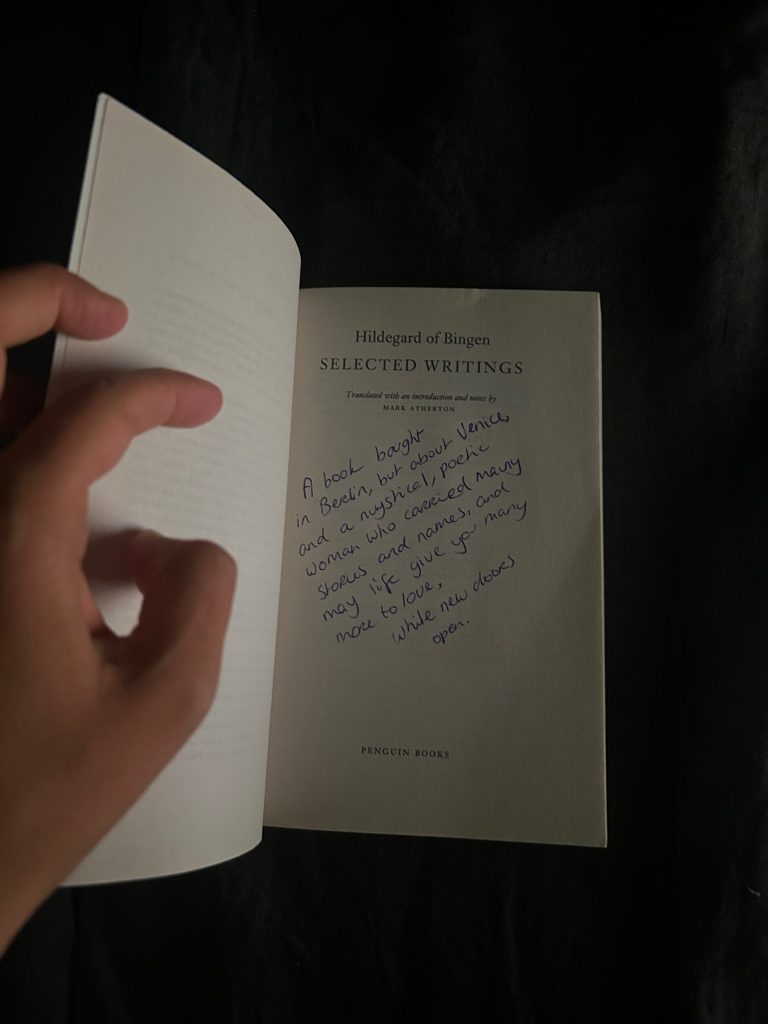
Heldegard of Bingen connected us actually, on a meta level first, then on a physical lever after.
Sasha Waltz had introduced me to Heldegard of Bingen in Berlin last year, and Tessa said she had bought the same book in Berlin. So Berlin must be the place.
Then Venice.
Then Amsterdam.
Then Milan.
Tessa, is among other, a project manager of Soundwalk Collective, the team and all artists behind the Vatican Pavilion at this year’s Biennale curated by Hans Urlih Obrist which, incidentally, was inspired by Heldegard of Bingen.
I told her: You made my day.
Sometimes a day is made by a book. Sometimes by a person.
Sometimes by the fact
that someone thought of you
before you woke up.
Tessa went to meet Simone
at Lacoste Café near my apartment in Gioia.
I stayed with my MacBook
and the small bureaucracy of existence.
Later I joined them.
They were already deep
in a Soundwalk talk. Not a walk.
A talk.
Perhaps that is also a kind of walking.
I arrived and Simone pulled the whole bench out for me. I could have sat. I could have lain down. The bench was exactly my proportions. This is rare. Furniture almost never understands the body.
Simone went aside to finish a call.
Tessa and I ordered water and drank it in one go.
Ritualy.
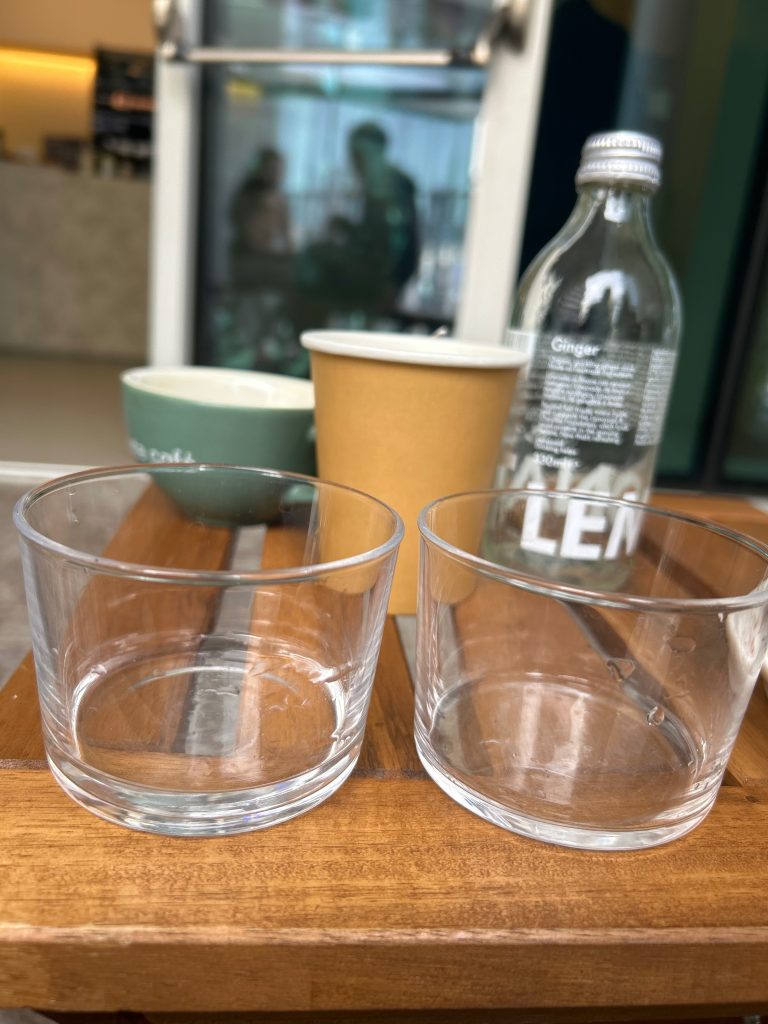
We talked about perfection and synchronicity of yesterday. We called yesterday: SUCH A PERFECT DAY.
Today was also such a perfect day. But not as perfect as yesterday. Some days are perfect. Some are more perfect. This is an unfair system but apparently it exists.
Tessa opened her computer to finish her emails. I put Lucio Battisti on my speaker, out of blue: Amarsi un po’.
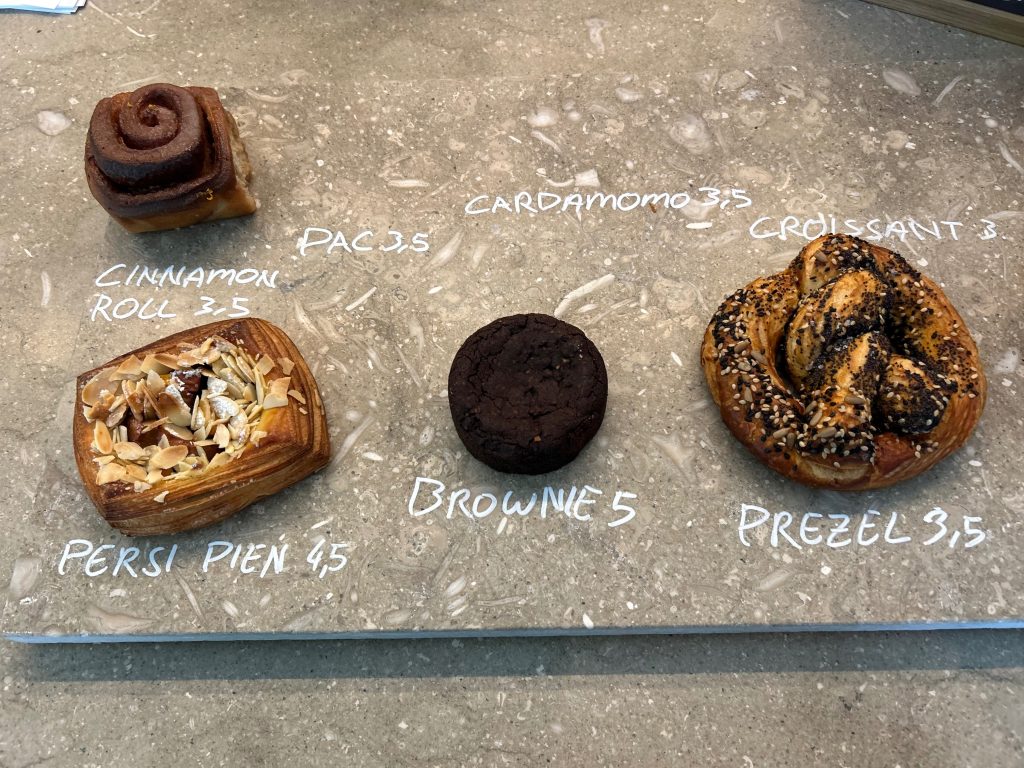
I ordered two vegan brownies
and one decaf cappuccino.
Then Simone came back. He had just moved to Milan
with his family. From Berlin. I thought: Why?
Then he told me
he was Italian,
born not far from Milan.
Then he said:
Now I have to jump into a day.
I said: you mean, you have to leap into a void?
and I asked him does he knows photo of Yves Klein called just like that (Saut dans le vide, 1960) is a iconic photograph that blends performance, illusion, and a highly choreographed setup.
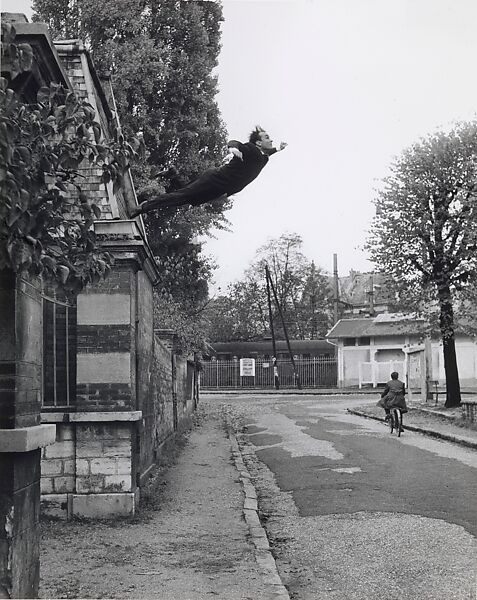
I told Simon that he looks like Yves Klein.
Tessa googled Yves Klein to see how much he resembled Simone.
We looked. Then all three of us agreed: Simone really does look like Yves Klein.
This is how art history sometimes enters a café. Not through a lecture. Through a face.
Then we mentioned our mutual friend, Ivana Lazarovska.
He asked me how she was, where she was.
There she is, in NYC, I said.
Simone left. Tessa and I stayed.
Our shirts were pastel purple. Almost the same purple. Mauve.
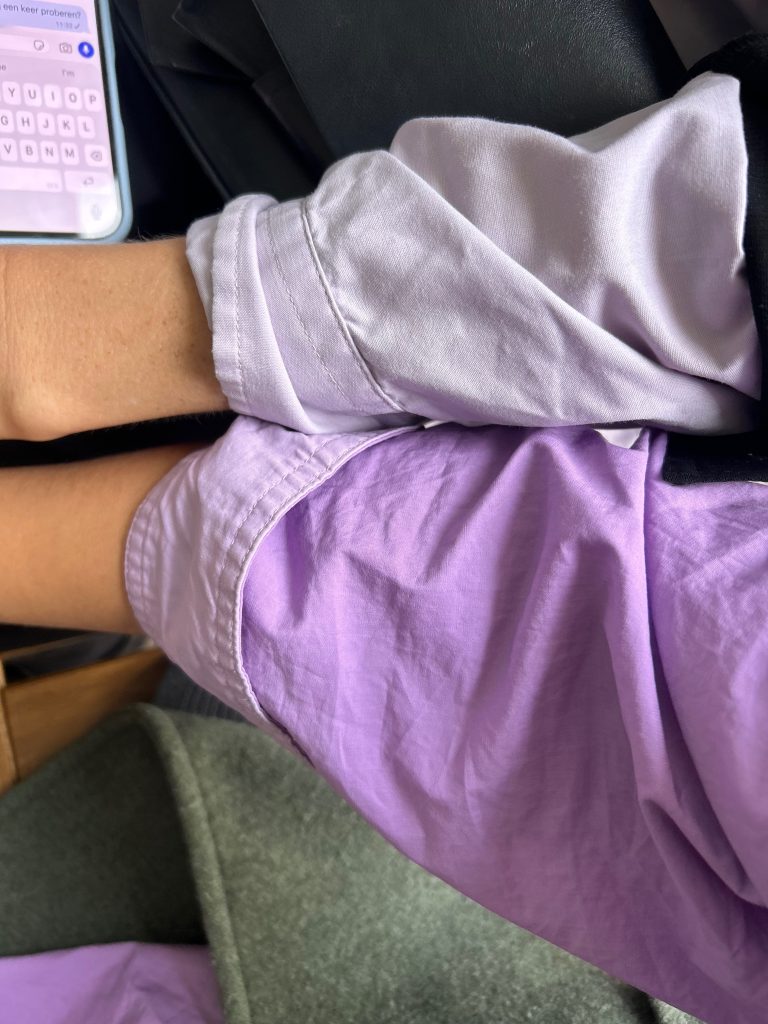
Matchy-matchy. We photographed them. We kissed. We wished each other: Such a perfect day.
Then I went to Naturasi shop.
on Via Gustavo Fara 35.
Naturasi is my Louvre. I enter and something in me becomes organic.
Happy without argument. I bought vegan kefir, and the Bio Vegan coconut yogurts:
blueberry.
lemon.
strawberry.
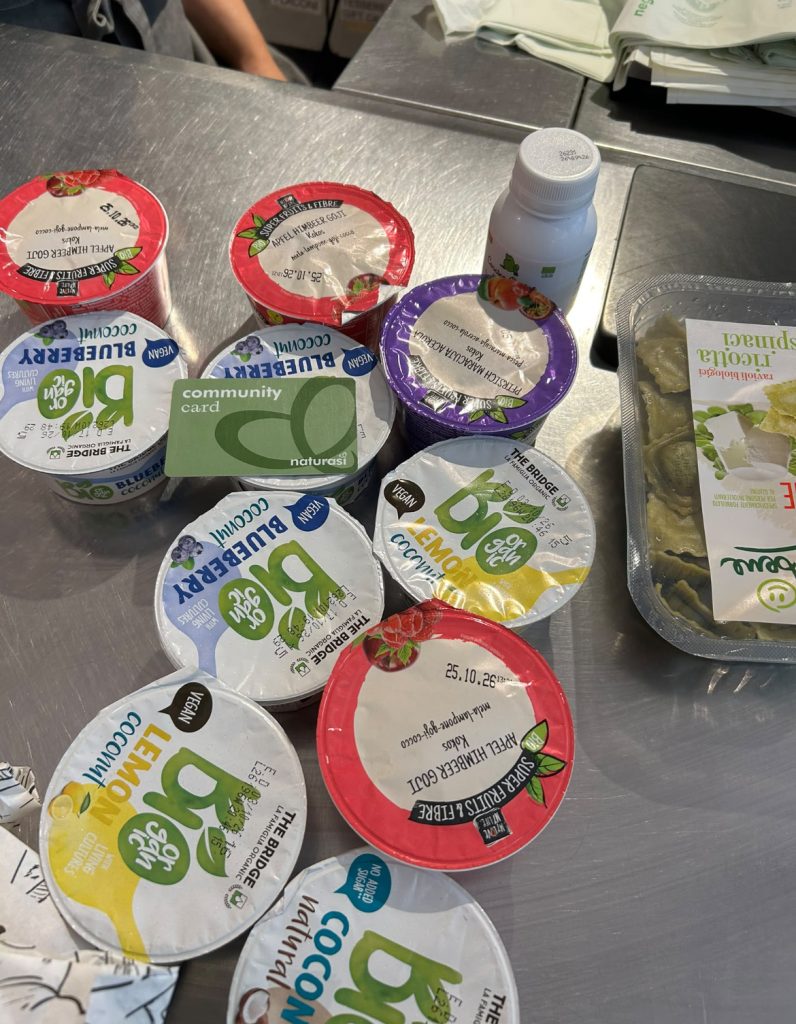
There is a very particular happiness in seeing a full bag of yogurts.
Dopamine rises. Then the cashier. The receipt. Dopamine falls. The economy of pleasure
is very efficient.
On the walk home the rise and fall cancel each other out.
By the time I arrive home, I am neutral again. Which is another word for happy.
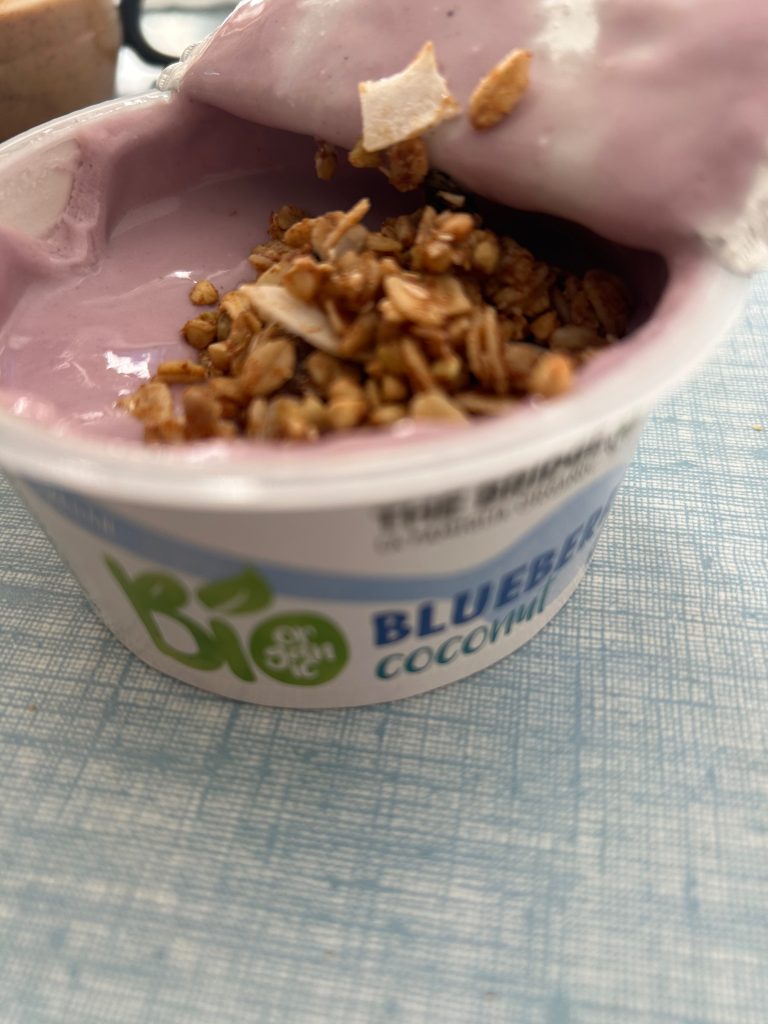
I eat the yogurts. The troubles disappear. Not permanently. Just long enough.
Such a perfect day.
Then I texted Davide: What time today?
He answered: It begins at 7, so it’s okay to meet at 6:50
We were both late. So we met there. The Voce room at the Triennale. An art talk. Iva Lulashi and several other artists. I didn’t know them. I knew just Iva. Then I bumped into Vito Vicino again. He smiled and smelled again, so nice.
Davide and I went looking for somewhere to sit. On one of the armchairs was Davide’s friend Andrea ( From this point on, I’ll refer to him as Adriano Celentano. Somehow, it sounds better to me )
We said hello. Almost immediately he asked what language we should speak. He said English was fine. I said: It’s fine for me if you speak Italian.
Then he asked: Do you understand Italian?
No, But I will pretend I do, that’s what I said.
This seemed reasonable. He asked where I was from, because he told me that he speaks several languages, including Greek, and he was hoping that perhaps it might be my native language, the one we could communicate in. And he began to examine me
as if a face were a map.
Greece?
Persia?
Iran?
Somewhere in between?
He was reading the construction of my face for geographical evidence.
I told him: You’ll never guess where I’m really from and I’m almost certain you don’t know my native language. I come from another solar system. We don’t use language there. We use other forms of communication.
We laughed.
Adriano Celentano continued guessing. He refused to surrender. He kept moving across the map until finally he came very close.
Then the art talk began. Half in English. Half in Italian. At a certain point the Italian became very embroidery. I closed my eyes. I activated Pauline Olivero’s deep-listening technique. But this time I wasn’t listening for meaning. I was listening to the words as sound.
This was easy. I didn’t understand them anyway. A language without meaning
becomes an instrument. A word can be a small object in the mouth. A consonant can scratch. A vowel can open. A sentence can become
a piece of weather. Sound helps us orient or disorient ourselves. Sometimes both. Perhaps meaning is only one way of navigating sound.
Since arriving in Italy I have kept a file in my Notes. New Italian words. But I don’t write down what they mean. I write them down because of how they sound.
My private Italian dictionary is therefore useless to anyone trying to learn Italian. But useful to me. It is a dictionary of sonic events. That evening I added a few. Words I heard while people were talking about art. I didn’t know what they meant. I knew that I wanted
to hear them again.
Here are some words that entered my sonic vocabulary this night:
Bisogno
Kuore
Rumore
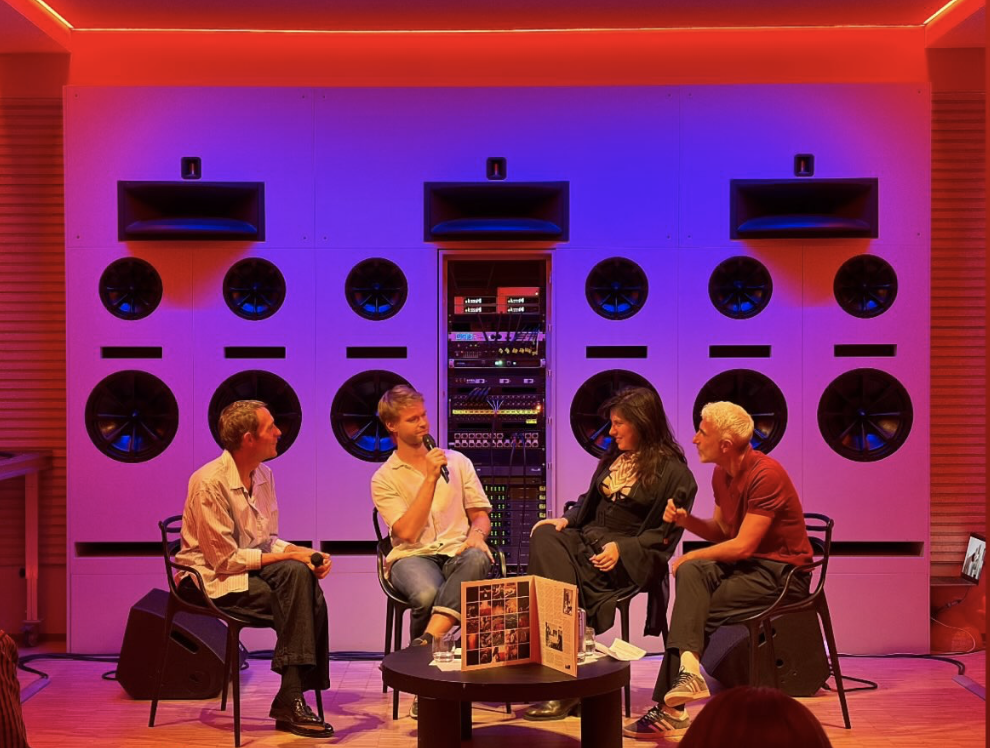
The talk ended.
We went outside for another kind of conversation.
Davide introduced me to the partner of Adriano Celentano, who had been conducting the art talk, Damiano Gullì. Then came the difficult part. He didn’t know how exactly to explain who I was or what I did. I could see the sentence getting longer. I hate explaining myself. I hate repeating myself. So I Invented a very short answer for these situations.
Simply, I said: I am intergalactic diva. That usually does the job.
Everyone laughed.
Then another guy came over, shook my hand and said: I’m also a diva. I asked: An ordinary diva or intergalactic one?
Ordinary, he said.
Okay. Fair enough. That’s what I said.
Then Adrian Paci arrived. I was so happy to see him, like always. I hadn’t seen him since last year. We held each other in a long, warm embrace and I turned to Davide and Adriano Celentano and said: This creature is the main culprit responsible for my ending up in Milan.
First, he recommended me to Susanna Ravelli for the Casa degli Artisti residency, where I stayed last year. And now I am at Viafarini. Not directly because of him. Indirectly. Which is sometimes the more interesting form of responsibility.
At some point someone said I was crazy. I don’t remember who.
I said: I’m not crazy. I’m just poetic.
Then they found a more appropriate Italian word. If I remember correctly:
solare, or maybe matta. I liked both, they sounded good.
I wrote them down in my phone notes and Adriano Celentano said:
You are like the sun and then Adrian Paci add: but you are far more unpredictable
than the sun. We laughed.
I love Adriano Paci, because he is real, he is generous and he has a great sense of humour. Not only a talented artist.
The conversation began to move from one subject
to another. No one seemed to mind. There was warmth in it and rhythm.
A love the feeling when conversation has own rhythm.
Then our legs began to hurt. So we went to sit in the garden of the Triennale. The garden was beautiful.
We talked about Matthew Barney and, Philippe Parreno again Pierre Huyghe.
Davide told me he fell in love, I mean, actually he rise in love, with Matthew Barney when he was still in high school, after his art teacher showed him his work.
I understood.
Some artists enter your life before you know that they are entering it.
We also talked about Ivana Bašić.
Davide told me that, once, Ivana had told to him, very directly, that he was ”stupid” for living in Milan. That Milan was not city for him and his work. That he should move to Berlin. I agreed with everything Ivana had said.
Then we talked about sonority. About what I am doing at the residency. I told them that I noticed two things immediately:
First: the voices of twelve artists inside one room, echoing of the voices and noises of 12 artist talking at the same time. Hallucination.
Second: the tiny movements of another population – their Highnesses: the mosquitoes.
The space itself and sonority of it is material for my work at my residecny, twelve artists sharing air. Voices dissolving into one another and then sonority of mosquitoes.
Davide told me he collects insects and larvae. He finds their cycles poetic.
Reproduction.
Death.
Hatching.
Transformation.
Eggs.
Larvae.
Again.
Again.
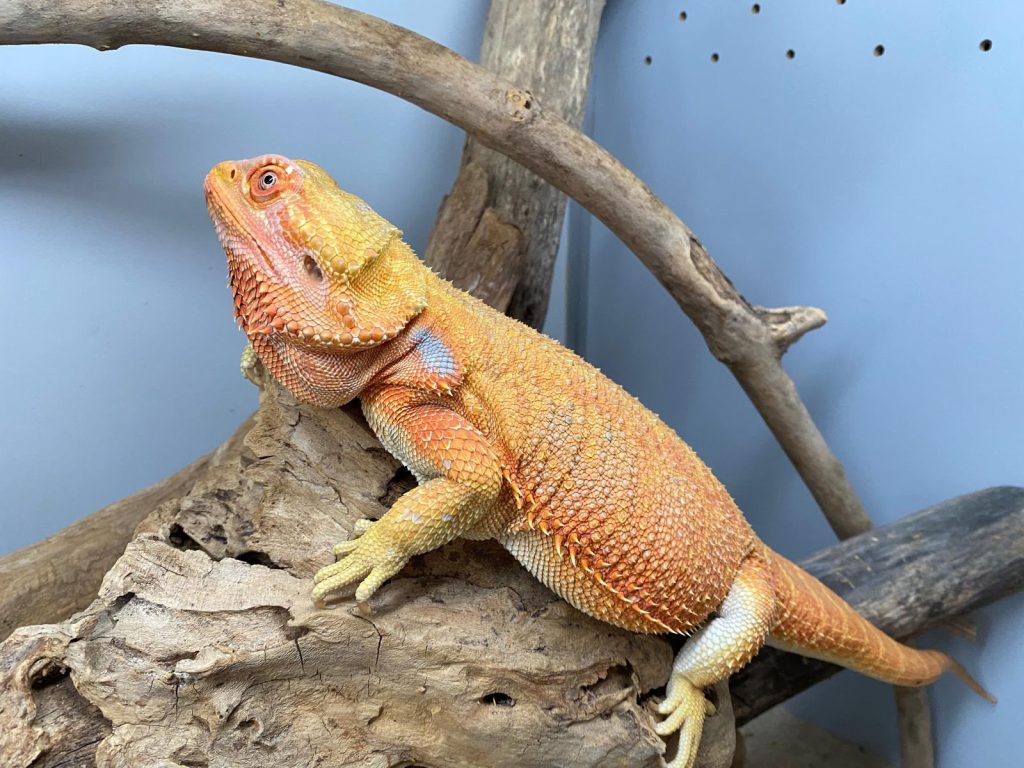
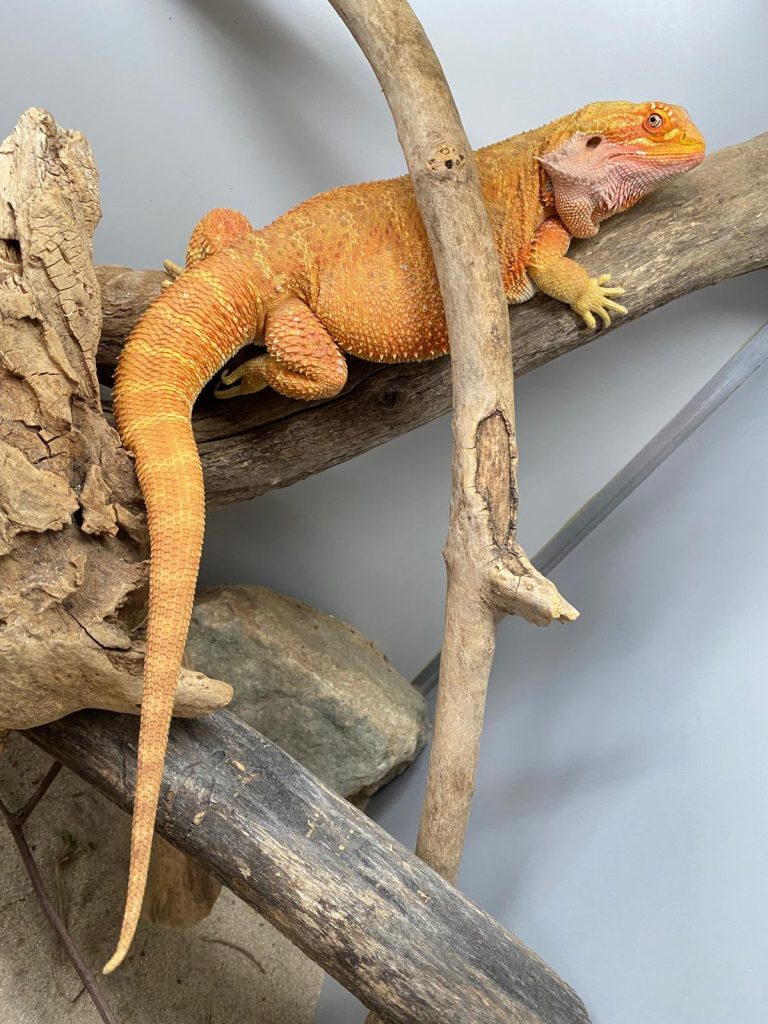
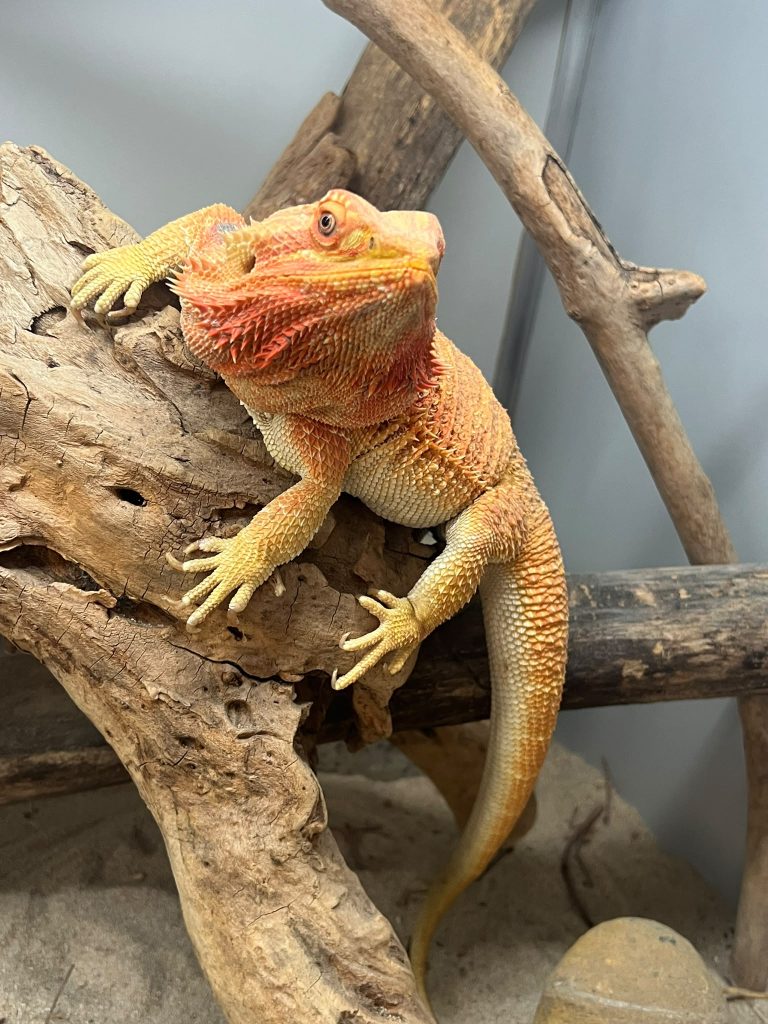
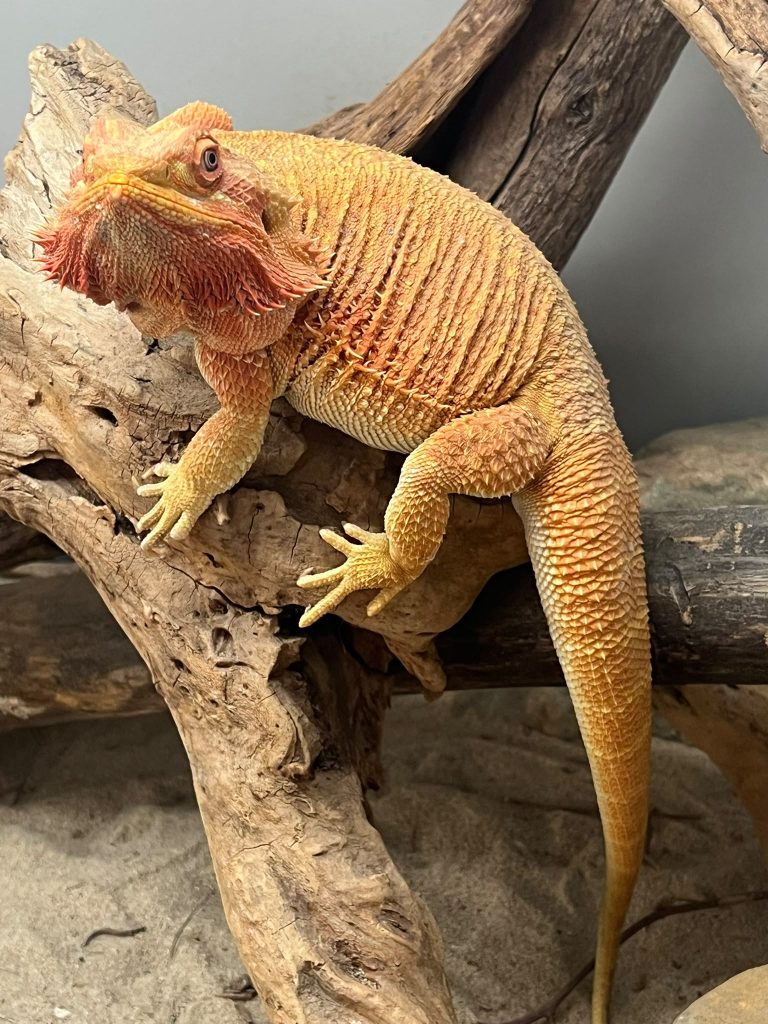
A whole universe that does not require our permission. Then he showed me his drago barbudo. He said: she is my lover.
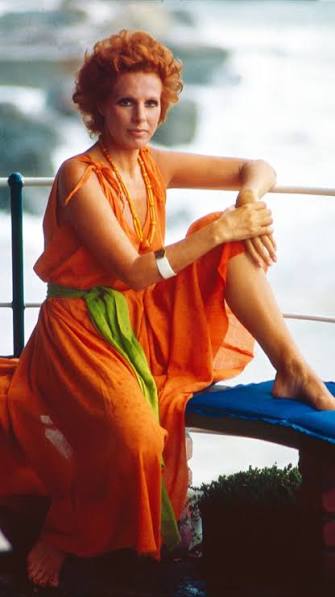
I have forgotten her name. It was some Italian name, something like Laura Pausini, but is not Laura. His drago barudo lover is orange. So I said: She can also be called Ornella Vanoni.
Then I told him about bug music, a musical genre built from the sounds of insects.
Davide loved this. He wrote it down in his notebook. Now we both had notes. He was collecting insects. I was collecting sounds. The conversation returned to sonority. How sound can orient or disorient us.
How you can recognize a place before you understand it. I told them about Acoustic Justice, book by Brandon LaBelle that I use as one of my references at my residency.
Because I am thinking about who gets heard. Who gets drowned out.
What a space does to a voice. And then there is Davide’s:
MAAA DAI
He says it often. But when he says it, it becomes something else. Not language. Melody. Harmony.
MAAA DAI is so sonorous to me, so musical, so eloquent. it’s sound to me like I hear Wagner’s prelude from Lohengrin. Not because of the meaning, because of the micro tonal movement inside the melody.
I asked Davide to record a voice memo saying: Ma dai.
I am collecting sonic material
from Milan. Anything I hear that might become material for the work.
Milan is beginning
to speak to me.
Not in sentences.
In fragments.
In vowels.
In noises.
In bodies.
In insects.
In cafés.
In “ma dai.”
and I am ready to hear it and catch it.
Then Davide revealed another sonic world. Apparently there is a very familiar sound
Italian men make when they see an attractive woman.
Not a word.
A whistle.
He demonstrated it. I asked him to record it. Another tiny piece of sonority of Milan. A language without vocabulary. Then he gave me a direct reference, and a better example of Jessica Chastain, speaking and whistling precisely that.
At some point we talked about Laurie Anderson. The day before, her email had arrived. So naturally I brought Laurie into the conversation and I told them about the longest Italian sentence I know. I learned it exactly from Laurie. I learned it for a very specific purpose: so that when someone asks me if I speak Italian, I can pretend that I do. And I do. In a way.
It took me three days. Three days of listening to Laurie on repeat. I listened until the sentence became a physical object in my mouth. Until I could say it without one mistake.
I performed it for them. They laughed. Then they admired
my Italian accent. Which was, of course, the entire point.
I had learned a language
in order to deceive people
for approximately thirty seconds.
Then the mosquitoes returned.
They were flying around us, small, persistent, almost musical. And I told them about an idea I had: a flying sound installation. Objects suspended in the air like mosquitoes. Except they would not bite. They would not produce that irritating minimalist drone
of the real mosquito. They would sing.
I would make sonic mosquitoes – flying bodies of sound.
And inside each one I would trap a voice. A mosquito will carry a tender melody. Each flying object will carry within it a specific tone, pitch, and melody, in synergy with the other flying objects suspended in the space, together creating the sensation of listening to a symphony orchestra. In the end, no one will be afraid of mosquitoes anymore, because these will be mosquitoes that do not bite, but caress you.
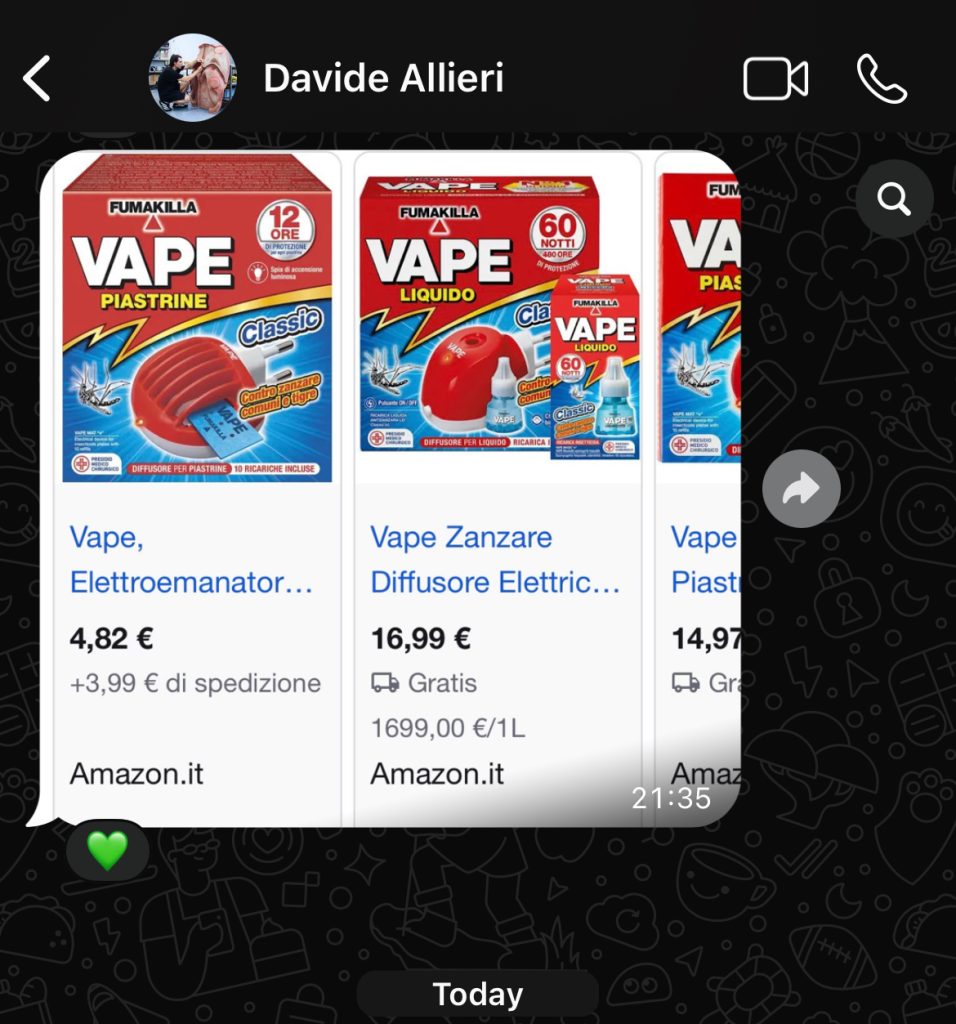
Before we got up, Davide sent me a photo on WhatsApp of the best mosquito repellent to buy for Via Farini.
Eventually the Triennale began to close. We had to leave.
Davide, Adriano Celentano,
and Damiano invited me to dinner.
So we walked and naturally
we continued talking.
Adriano Celentano and Damiano Gullì were faster than us. They were ahead of us, walking in their own dimension. Davie and I were moving in our own dimension, which was just a little behind theirs.
The conversation had no road. It had weather. We moved from one subject to another,
then another, then back again. At some point we talked about Cattelan. Davide remembered the first time he met him in Bergamo.
Cattelan had said to him:
Davide, la tua fama ti precede.
We laughed. Then Davide said: But you can never believe
anything he says. So that was half true – half a joke.
I said: Yes. That is Maurizio. I believe him because he is a white ‘liar‘.
Eventually we reached the Chinese restaurant.
Finally:
Chairs.
A table.
A menu.
They translated simultaneously from Italian and Chinese. I only had one condition: no meat. I haven’t eaten meat since I was little. I chose the best possible thing: soy noodles with vegetables.
Then I ordered water. In perfect Italian: “Acqua naturale a temperatura ambiente, per favore.” They said I sounded completely Italian. I told them this was Adriano Paci’s fault, again. He taught me this. Because whenever I am with him I drink only acqua naturale a temperatura ambiente. There are people who teach you a language. And people who teach you how to order water. Sometimes they are the same person.
While we were waiting for the food, something happened to the light. or perhaps it was their skin. I looked at Adriano Celentano, his skin was glowing, hydrated, very hydrated.
I asked him: What is your skincare routine? What cream do you use?
He said: Esselunga face cream.
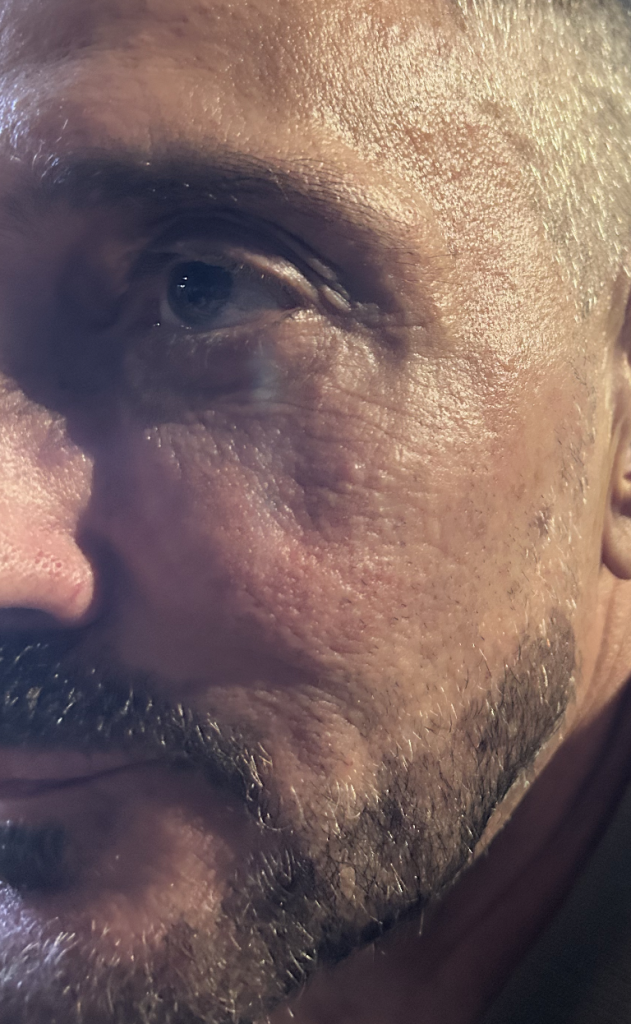
Davide added: I use an even cheaper one. Lidl face cream.
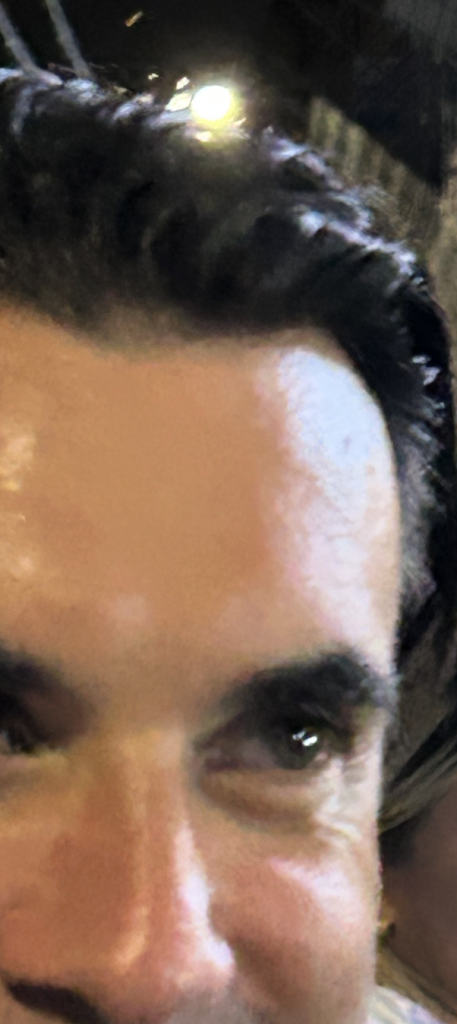
This seemed important.
I told them they should both apply to become the representative faces of Esselunga and Lidl. Their sales would increase. Capital would begin to circulate. By a minimum of 37 percent.
Then I told Davide how many of my female friends had reacted to his photograph, in my diary a posted few days earlier – how they had read about him and wanted to know who this was.
I replied that he was the Italian Keanu Reeves and that he was taken. He wasn’t. But I said it anyway.
Sometimes a small lie
is a form of protection.
Especially when you know
exactly who is asking
and exactly why.
Some people, I said, simply do not have the immunity to beauty.
The plates became emptier.
The table became emptier. Eventually there was nothing left to keep us there.
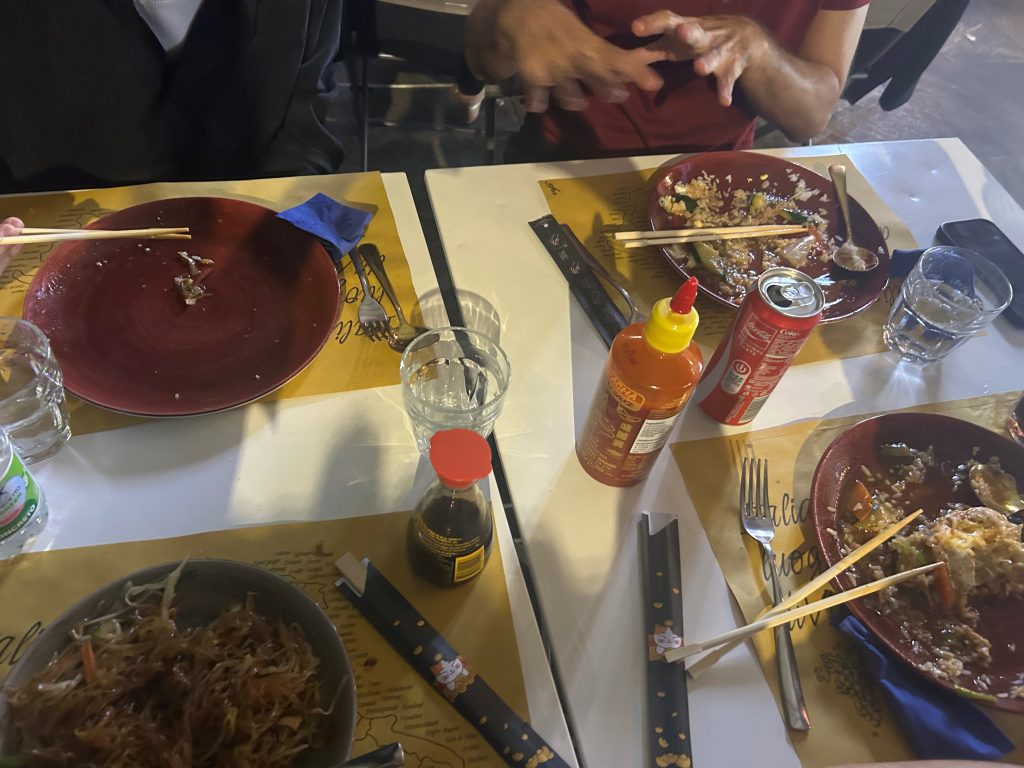
We paid.
Adriano Celentano and Daniele Gullì went in one direction.
Davide Allieri and Julija Castellucci in another.
We walked toward Porta Garibaldi. He was going to take the metro. I was going to take
my green horse. Lime.
We had about ten minutes
to walk to the station. Ten minutes is enough for a conversation to become another conversation.
We talked about astrology. I had looked at Davide’s chart
on Astro app. Venus in Pisces, around 20 degrees.
And then I checked his chart
in Vedic Jyotish astrology
and saw it:
Moon in Taurus.
Rohini nakshatra.
Ah.
No wonder he is an emanation of beauty.
Rohini – the personification of beauty, sensuality, aesthetic grace in their highest manifestation.
Extremely.
Rohini does not simply notice beauty.
It needs it.
It produces it.
Rohini has very little patience
for ugliness in ay possible form.
I told him that people
with Rohini in Taurus are hypersensitive to beauty and aesthetic. They cannot bear ugliness.
I am one of them. My Moon is also in Taurus, in Rohini nakshatra.
I had never met a man with Rohini in Taurus like mine.
So I was pleased.
A shared taste for beauty.
A shared aesthetic.
A shared problem.
Then two girls walked past us
in miniskirts. Perfectly constructed legs. We looked. The beauty of legs
passed through the conversation without saying anything.
Davide said: Well: I’m going in that direction. Following beauty.
We laughed. Then we hugged. We said we would see each other, but not too often.
Because we are both too sensitive to beauty – both with Rohini in Taurus.
If we see each other too often, there could be double trouble – double beauty.
and just as I was finishing writing this diary, a reply from Davide arrived on WhatsAapp:
The name of his Drago Barbuto is Agatha.
Not Laura,
Not Ornela,
but Agatha itself.