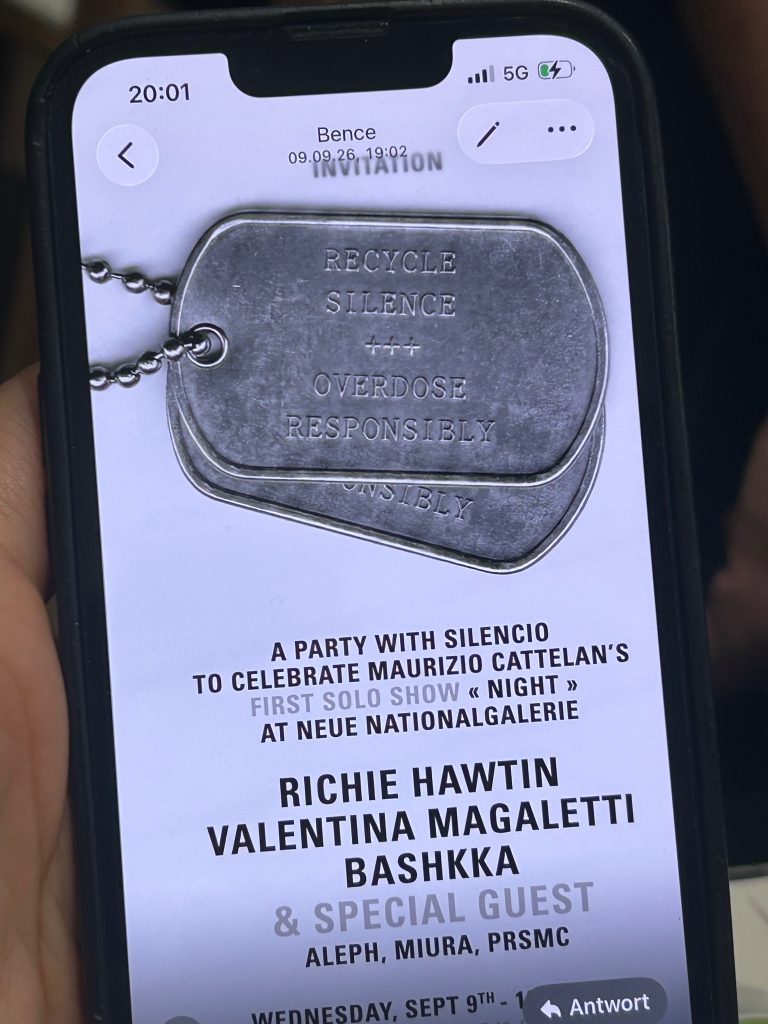
I have a Cattelan hangover.
The same kind Anne Carson had from Rosalía.
Not the usual kind of hangover, although there was certainly something physical about it. Berlin gathered itself around one man that evening – a man who, among other qualities, has built his career on bringing people into a state of uncertainty before the question of what, exactly, they are looking at.
The line was so long for the long-awaited opening. There were three separate lines: one for ordinary mortals, another for invited guests, and a third for the press. The line for ordinary mortals was, of course, the longest, and some people had been waiting for so long that they had even brought chairs to sit on while they waited.
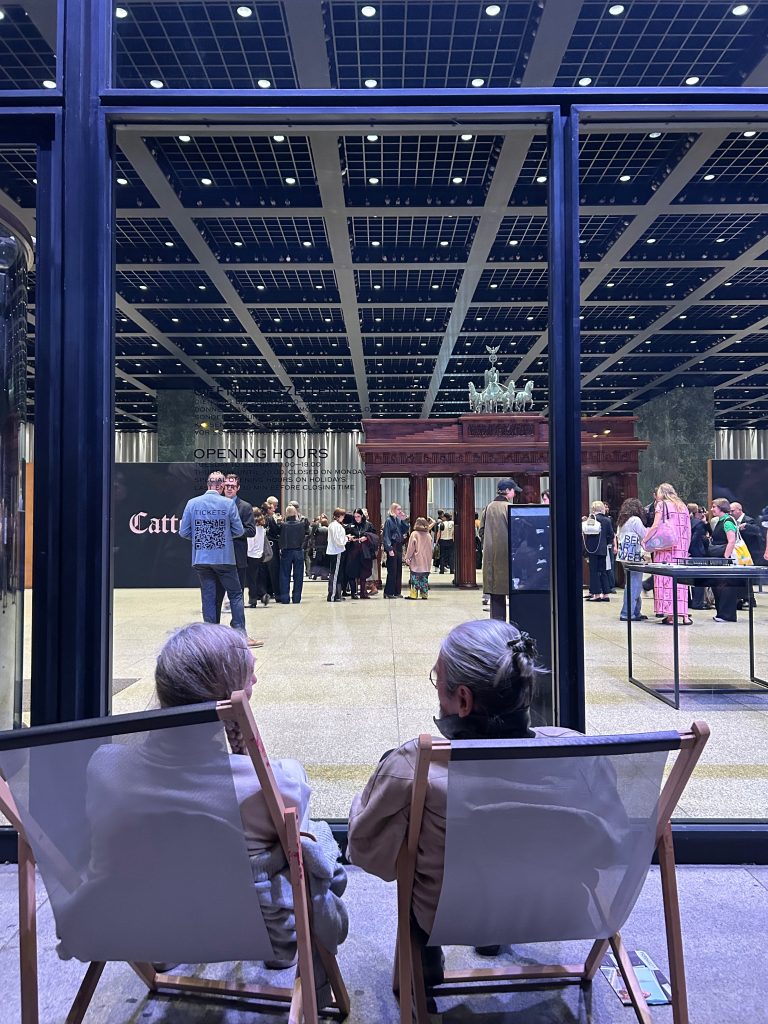
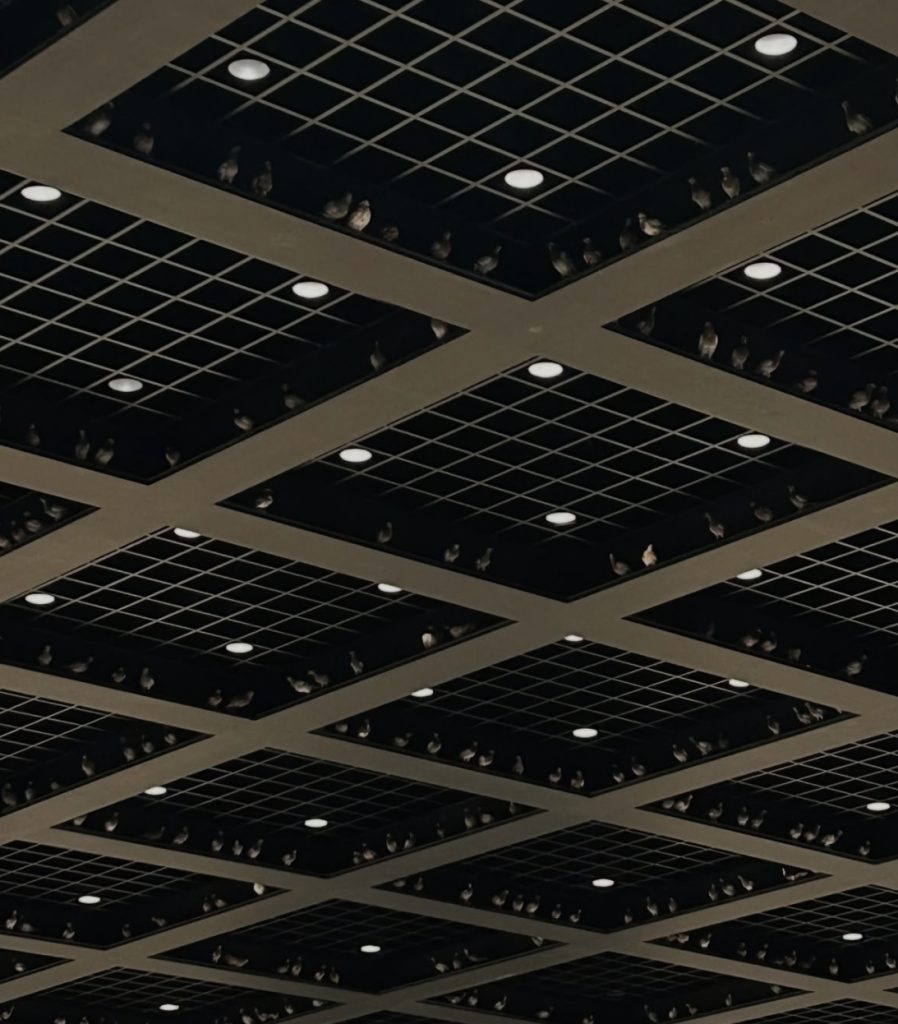
Mies van der Rohe built a masterpiece for himself.
And this creates a strange problem for everything that comes after.
Any work of art placed inside the Neue Nationalgalerie is, from the beginning, predisposed to failure. The building has already achieved its perfection. It does not merely contain the work. It looks at it.
But there are artists who understand that the only possible response to such a building is to think harder.
To try to reach Mies.
Or at least to keep pace with him.
To enter the building not as a guest, but as an interlocutor.
Perhaps this is what it means to exhibit here: not to overcome Mies van der Rohe, which would be absurd, but to make the attempt.
To place one mind beside another.
And see what happens.
Inside, people stood around the works with that strange mixture of seriousness and anticipation that contemporary art produces when everyone suspects there is a joke hiding somewhere, but no one wants to be the person who laughs too early.
Cattelan knows this space very well: the interval between recognition and discomfort.
A figure appears. An object interrupts the space. Something looks familiar, and then becomes impossible to define. You understand the image immediately, and then you no longer understand why you are standing in front of it. This is part of his particular kind of violence. He does not have to explain the joke. He lets you finish it yourself.
What is strange is that at a Cattelan opening, the artist himself can become another work in the exhibition. People look for him. They want to see him looking at them while they look at his work. They want the proximity of the person who made what they are looking at, even when the entire logic of the work rests on the instability of authorship, value, and attention.
And Berlin is particularly good at this kind of contradiction.
The city has no problem accepting absurdity as a serious intellectual position. It allows a banana, a dead animal, a religious image, a child, ashes of a friend trapped in a fire extinguisher, a policeman, a joke, or a wound to occupy roughly the same cultural temperature. Everything can become a symbol. Everything can also become funny or serious.
Cattelan understands this.
His humor is never just humor. It is a mechanism for passing through the intellectual defenses we build around art. You laugh, and then you realize you have already participated. The laughter has opened the door.
I watched the visitors.
Some stood very close to the works, as if proximity might reveal a secret. Others stepped back, assuming distance would bring understanding. Phones appeared and disappeared. Someone whispered. Someone else laughed too loudly. One person stood completely still for several minutes in front of a work that, at first glance, seemed almost offensively simple.
What are we actually asking of art when we stand in front of it like this?
We ask it to surprise us.
We ask it to confirm that our surprise makes sense.
We ask it to make us feel intelligent without allowing intelligence itself to become too comfortable.
And perhaps that is why Cattelan’s work resists photography. An image is never quite enough. There is always something irritatingly physical about encountering an object in space: its size, its materiality, its apsurdity, its elegance, its refusal to become entirely symbolic.
The joke has weight.
The absurd object occupies space.
And suddenly the gallery, the institution, the people in expensive clothes, the conversations about art, money, and history – all of it becomes part of the work.
Perhaps that is the most Cattelan-like thing of all. He does not simply place an object inside the institution. He places the institution inside the object. And then he waits.
We are the ones who begin to explain. We are the ones who become uncomfortable. We are the ones who decide whether we are laughing at the work, with the work, or perhaps at ourselves.
There is something almost cruel about how little Cattelan seems to ask of us.
Much of contemporary art demands interpretation. Cattelan often demands a reaction first. Interpretation comes later, usually on the lime, uber, or train home.
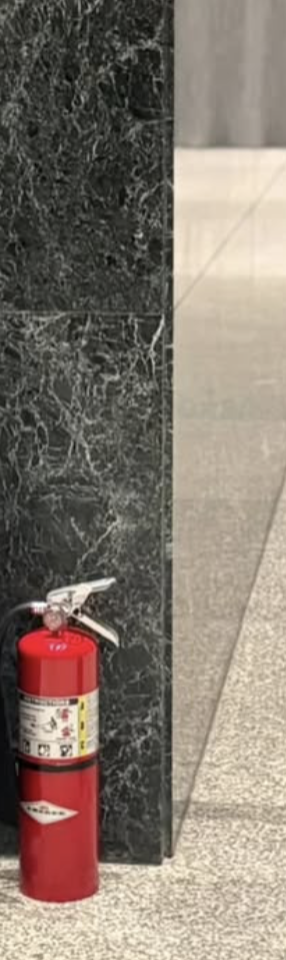
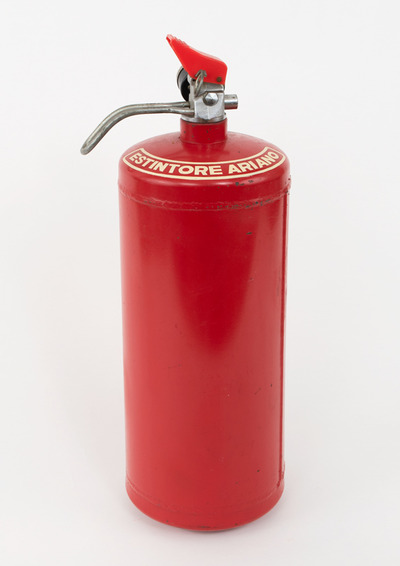
The fire extinguisher. Inside the ash of Cattelan’s friend. I never imagined a fire extinguisher could move me, and it really happened. This one really moved me so. Because I knew the context behind it.
The object is no longer simply an object.
Cattelan, like Michelangelo Antonioni, knew this:
that a room,
a wall,
a landscape,
even a fire extinguisher
could become almost a character.
Inventor e legislatore.
So how does a fire extinguisher become poetic?
It simply waits there, holding its red silence, holding its history, almost an Antonioni shot. The kind of shot Pino Farinotti might have paused to explain.
One might call it inheritance or appropriation, and I suspect, Fabio Mauri might have known the difference and would have call it good taste, with better lighting.
The Berlin air was cold and sharp as we left the Neue Nationalgalerie.
The opening quickly dissolved into the city. People disappeared into taxis, the U-Bahn, restaurants, hotel lobbies. The works remained behind us, completely still, continuing their strange conversation with those who had not yet learned how to leave them alone.
Cattelan’s audience: I don’t know what to make of us.
Sometimes a great exhibition creates the illusion that everyone in the room has understood the same thing. For a few hours, we mistake proximity for communion. We stand before the same objects, breathe the same expensive air, laugh or cry at approximately the same moments, and call this a shared experience. We stood together before the same objects and pretended, with varying degrees of confidence, that we understood it.
And then we leave. And the wonder disappears.
Whatever we thought we understood inside the museum stays there. Outside, the city continues as if nothing happened. People return to their conversations, their phones, their cars, their lives.
There is no shared answer waiting for us. No single meaning we can carry home.
There is only each of us, alone again, with our private version of….
Perhaps that is Cattelan’s real trick.
He makes absurdity public and meaning private. He gives everyone the same object and sends everyone home with a different story.
And then came a sonata of unplanned noise at Silencio’s temporary Berlin home, the old Watergate on the Spree.
Klaus Biesenbach and Lisa Botti were in the shadows during the opening; I only really noticed them there, at the after-party.
It struck me then how precise their taste is when it comes to art – how exquisitely they recognize an object, a sentence, a historical reference; how quickly they can locate an artist within a lineage, detect a gesture before it has acquired a name, and distinguish what is merely fashionable from what might, eventually, become important.
They have an almost unnerving intelligence for these things.
And then, mysteriously, that intelligence deserts them when music asks the body for an answer. They simply have no ear for rhythm. Their bodies seem to encounter music as a foreign language: grammatically present, rhythmically illiterate. But this is not their fault. Taste and dancing style, after all, is not a democracy. Some things are given to us. Others are not.
Valentina Magaletti was waiting for us there, giving the night a tempo in which some hearts would later beat faster, and others would skip.
The room gets darker. The art-world conversations become louder and less intelligible. Money becomes rhythm. History becomes noise. Reputation becomes sweat – everything slowly turns into noise. Valentina begins to play, and suddenly nobody needs to explain anything anymore.
The bodies take over.
The night acquires a tempo.
Valentina gathers momentum so softly that when I closed my eyes, I heard a melody hidden within her rhythm. For a moment, I thought Midori Takada was playing in front of me.
And suddenly the body understands something the mind has been trying too hard to explain.
People dance. Badly. Beautifully. Expensively. Desperately.
For a few hours, we stop being critics, collectors, curators, journalists, artists, friends of artist, people who know people who know people.
We become bodies again. And this is part of the exhibition. Perhaps the artist knew this all along. Perhaps the joke was never inside the object. Perhaps it was waiting for us outside it.
By the time we leave, the books have been signed, the photographs taken, the banana breads eaten, the interviews given, the smiles exhausted.
Maurizio has disappeared.
The works remain somewhere behind us, perfectly still, waiting for the next group of people to arrive and make the same mistake in a completely different way.
I am still thinking about Cattelan, not his work.
Or perhaps I am simply drunk from all that room-temperature water I drank that night, because the drinks at the club were free.
I still have a Cattelan hangover. My left leg still hurts. I have no idea why.